Monday, November 30, 2015

FFF

FFF. Form Follows Function. Every contemporary designer aspires to reach THAT moment of the (in)famous concept of clarity in design. The term is a simple way to describe a level of purity in design. A moment where all the ornaments are pealed back, and you are left with the bear minimum needed to sustain the function of the chair/building/kitchen. 

Alexa's beaming 'circle of death'
This weekend as we were putting our christmas tree up, we were joined by a new member to our technical family - Alexa; a wireless voice activated speaker. The joy in our household quickly fizzled as it was clear Alexa was all Function and no Fun, the ultimate electronic FFF. Unlike Apple's Siri, Alexa would not respond to silly questions my 6y boy had come up with, leaving him hanging with her blue round 'circle of death' (as my 10y calls it) beaming in front of his eyes. I'm no Siri fan, to be honest all these voice activated devices make me feel uneasy, but at lease she has some artificial intelligence sense of humor built into her. 

Looking deeper into pure functional form of things is a true design exercise. I'll be the first to admit that I too, am a purist, coffee will be coffee no hazelnut-vanilla flavor for me, and I admire clean modern lines in clothing, furniture, light fixtures, and spaces. Usually things that are made to function well, will be less wasteful and harmful to our environment. BUT then I find something is lacking. A human touch, a smile, a sprinkle of sparkle. 

As we brought in our christmas tree, our usually clean lined home, suddenly became friendlier. It smelt like pine, and by the time we were done decorating our spirits were happy and joyful. If ever there was an antithesis to FFF - it's christmas. It's not sustainable, no clean lines, no function what so ever, and full of ornaments. What a christmas tree lacks in function it makes up for in full blown spirit, a magical feeling that we can put last year and it's troubles to bed, that rejuvenation is on its way. Not functional, yet truly valuable for us as humans to feel. 

We should not want to live an a highly functional society that in many ways acts like Alexa. Just looking into the personalities that have brought the likes of Siri and Alexa to the world will allow us a window into the algorithms that rule our day to day searches, and more important - finds. They narrow our peripheral view of things in life, they eliminate exploring further in new ways. This is alarming because as much as I like clean lines, and functional spaces, I love having happy sloppy and messy mistakes that allow me to pause and smile, remind me that after all I am human that not only Functions but also Feels. 

Monday, November 23, 2015

Happy Medium

There is no bigger evil in the world of the over achieving, insta-go-getting, facebook high rollers, than the word m-e-d-i-u-m. It's this stuck in the middle, static, neither here nor there option in life. It's not the cream of the crop, or the lowest of the low. A mentality of 'I'd rather miserably fail than be defined as mediocre'. No wonder there is the known phenomena of the "mid-life crisis". There is no sex appeal in middle. 


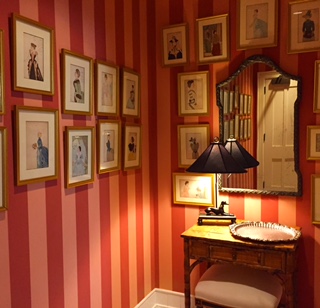
The pink logo creates a surprise in a 
well balanced space 
Or is there? 

It seems that humans have developed this odd, almost counter intuitive knack, to push boundaries, which is completely against any natural instinct. Nature always wishes to balance, to reach equilibrium. We as humans want for some unknown reason to defy that force of nature. We sleep less than we need to, we eat more than we should, we work longer hours, and in general don't really take very good care of ourselves and our environments. 

As a designer I like to keep things off balance, surprise the user of the space. I'll use bold colors where you won't necessary expect them. I'll align certain things that will keep you on your toes. But it's a delicate process that can't be done on a whim. These mis-alignments can only be done right when you have a balanced and clear idea, and when there is a solid anchor you can play off of. Otherwise it creates clutter, uneasiness and in general a feeling things were not thought out properly. So there is, you see, a certain method to the design madness. 

That is why a Happy Medium is one of the most critical things in our daily lives, and is one
of the hardest things to come by. (Ask any GC trying to level floors inside old homes). We need the temperature of the HVAC to be almost exactly the same in our work environments. Lighting and its brightness need to be precise. The height of our kitchen countertops is meticulously measured. 
The seemingly cluttered and uneven photo alignment is 
made possible due the well balanced and centered table
& mirror. 
The length and height of stair risers. All of which are meticulous averages, which years of usage in the world have managed to come by. These "lowly" mediums are the anchors of our day to day life, the blocks from which we are allowed to soar to different places. In my view "Average" should be proclaimed as a new goal, a place we all should aspire to reach, a balance that redefines our center lines, and alignments. A Happy Medium. 


Monday, November 16, 2015

Mindful Act of Kindness

When my soon to be 10 year old girl was about 4, she was brushing her long golden hair. She looked up at me and asked 'why do I need to brush my hair each and every morning?' My response was 'because by doing so you respect yourself, and respect your friends and teachers'. 

I was never a fan of Feng Shui, or to be precise, its watered down western interpretation of it; Closing the toilet seat to prevent your money escaping your wallet, never have a staircase facing the front door, never put a chair with its back to the door - are some of the highlights I can off handedly suggest. 

But a few years ago I had this small epiphany of why it mattered in our world. Why habits like making sure you don't squeeze the toothpaste in the middle mattered, why making your bed every morning matters, why putting a fork and knife in the right order matters -why these seemingly mundane tedious, and routine things matter. They create order, they create balance, and for control freak megalomanic designers (hey we are paid to build 'worlds') are a code and key to understanding human interaction and behavior within different environments and spaces. 

These random daily routine acts are mindfully observed and broken down frame by frame to create a narrative for a space. These 'mindless' acts being thought of mindfully are the difference between getting furniture straight out of catalog, only to discover these don't make your house feel like a home. 

It's attention to details in ways that are not obvious to the user of the space, but they make the user feel good happy and safe. They make people feel like they are cared for, and not taken for granted, that even though you can't exactly pinpoint what it is that makes you feel connected, you know you are. That yes, even brushing your hair in the morning, matters. It's a small act of kindness to yourself signaling that you will also make sure to be kind to others. 

Monday, November 9, 2015

Design on the Run

The other night as I meticulously laid out my pre-race paraphernalia on the dinning room table, a familiar sensation hit me. It felt like the night before a final review or a big client presentation. 

A festive almost religious like rhythm and movement comes to mind. Picking out the right running clothes, the socks, the race number, the power gels, the good luck charms, uploading the right playlist. 
Until running my fourth big run, I never realized how much the design process and long distance running have in common. 


Pre-race layout
I always worked while listening to music, a beat to which I would carefully glue the model pieces in their right place, or hand draw the envisioned elevations. When I look at past work, I will always know which tune I was listening to at that time. Every race I go to I have a playlist ready for the rhythm needed for that part of the run, the warm up music will be different than the one for running up that very long hill. Design projects will have the same process of warming up (brainstorming, sketching, etc.), the long and tedious main course of the run (building, permits, fixing mistakes), and finally the dash to the finish line. 

Long distance running requires training and careful planning. Good design does too. I miss having that process followed to a T. The haphazard approach people have to the design process creates for a lot of contention and costly mistakes. It's almost akin to a 5K runner suddenly asked to run the Boston Marathon over night. The damage that can happen to the runner is clear. The same is true for the design process, there is a careful methodology to it, and when short cuts are made in that process, spaces seem incomplete or just don't look or feel right. 

The most successful, and rewarding projects I have been a part of, are the ones when I'm allowed in on the 'warm up' phase. From the point of helping decide which space will work better for a new office, and its growing team; to running up the hills of painful budget decision making, and exciting new spatial moments, which in my heart I know will make for the best working environment for that team. 

Office kitchen lounge in the making 
And like with running, going all the way up to the finish line, when every fiber of my being is dead-on focused on getting it done right and on time, (the counter top edges should be mitered, the layout of the flooring, and the thermostat should not be in the middle of the feature wall...) one foot after the other. 

Monday, November 2, 2015

Commit to Memory

9/11 memorial museum entrance 
I was sitting in the car, the english countryside zooming past my face, and all I thought about was - I must remember the colors, the angle of the sun hitting so perfectly, and the exhilarating wind tangling my hair, this moment will never return. I was 8 years old, we were on our annual visit to the UK to meet friends and family. It was not an unusual or spacial trip, but from that moment on in my life, I have this nagging persistence to commit it all to memory, before that moment might be gone. 

I don't know how to design for memory or loss, and that is why I find many memorial museums and memorial sites so intriguing. It's such an intricate balance between conveying a message that will reside in peoples hearts without making them feel rejected, or that the memory of a loved one has not been overlooked. It is even harder to imagine how to convey these messages of private sorrow and loss, when they are part of very public national or international events. 

I grew up in Israel, a country that is constantly morning the loss of young lives, and that is burdened by the incredible loss of its people during the holocaust. A place where every rock you dig up has the explosive potential of toppling any type of balance achieved. In Jerusalem I was surrounded by historical and contemporary memorials, from the Western Wall to Mt. Herzl Cemetery. One of the places I played the most when I was a kid, was the Jerusalem Forest at the foothills of the Mt. Herzl Cemetery adjacent to Yad Vashem, the holocaust memorial museum of Israel. It probably triggered a curiosity in me that still lingers on.

How does one design for memory? How does one pick out the right words to write, and figure out the font that will be used? Pick out the right lighting, color? Create the most inclusive narrative? Curate the right items to be displayed? Make a memorial stay relevant as time passes by? I'm not sure there is a right answer to such an intimate thing as creating a memory.  
Jerusalem Westren Wall

The most powerful memorials that stayed with me along the years were the ones that maintained a sophisticated simplicity. Sites such as the 9/11 memorial where the missing buildings footprints portray the enormity of the loss, the Vietnam war memorial that has managed to leave out the controversy of the war, the children's memorial at Yad Vshem where light is used as a powerful tool forever immortalizing the lost spirits of 1.5 million jewish children, the cemented hole with olive tree splinters at the buchenwald death camp. These are sites that resonated with me, allowed me to morn a loss without judgement, they were humbling sites that created true moments of reflection. These places are committed to my collective memory. 

Monday, October 26, 2015

One for the team!

Last week I happened to listen to a piece on the radio about the decline of team sports in America. As a mother of 3 kids, 2 of which are part of team sports, it got my attention. Aside from all the back and forth about costs, lack of interest of the kids, helicopter parenting, etc. It got me thinking that in fact there might be a greater issue at hand, something that I worry about. I fear that there is a 'flattening' of our society to what the Blue Man Group calls the 2 and 1/2 dimension.
 
As a society at this point I find we lack rigor and will to make that extra effort. Most of us will admit we do not wish to spend the effort or time driving kids to god forsaken places to get ice-time or pool time, it requires effort, planning ahead, and yes dealing with an uncomfortable option your kid may lose. We want things to be happy, crisp, clean and so very easy, which is kind of like flat coke. 

This lack of rigor, commitment and effort hold true in many fields nowadays, the one in particular I'm concerned about is the area of design. Things look very easy on HGTV and it's off shoots, places like communal painter spots which allow us all to be Picasso for a night, easy measuring apps, 9 minute pasta dishes, easy 1 click furniture shopping, you name it. We are all short for time and by way of that we forget to stop and dig deeper into things, investigate them a little, expand our knowledge, and do some of the 'dirty' redundant work that is required. 

About 6 years ago, the Tate Modern in London held a special exhibition to celebrate the 10th year anniversary of its building. I have an affinity to this building, and greatly admire the Swiss architects, Herzog De Meuron who designed it. So my disappointment when I saw the turbine hall exhibitors, was huge. Here there was a once in a life time opportunity to articulate a thoughtful artistic display, and what it ended up being was a sad display of our declining culture. The exhibitors themselves were busy on their phones/computers "connecting" via social media. They forgot to connect their display to the building or the viewers who came to experience it, it felt haphazard, and not very well put together. 

But why do these things rub me the wrong way so much? Is there a connection between the lack of rigor and discipline to poor design choices? Maybe yes, maybe no. What I do know though is that good design requires attention to details not only to plans, flashy 3D models, but also to people and their behavior, culture and language. Good design can be full of humor and thoughtful when there is an investment in liberal arts and history education, not just when it comes from a DIY kit. 

Design is a language and as one who is bilingual, and studied a third - I can earnestly say that is requires rigor, and hard work, skills that in essence can be learned while doing team sports. 

Tuesday, October 20, 2015

No Name *

Branding // 
(as noun branding) The promotion of a particular product or company by means of advertising and distinctive design
Seems like everywhere you turn around these days one is expected to brand themselves, their work place, their product, you name it. That elusive quality that will distinguish them ahead of the pack, any pack. Starts from your web site landing page, Facebook page, twitter account, tumbler feed - you name it, you'll need to brand it. Better yet tie it all into THE brand. 

But you see good branding is hard to achieve these days, it requires something most of us don't possess - patience. In this fast track world of FB, snap-chat, insta tumbling sound bites it seems that no one is free from creating their own brand. A "brand" represents quality, identity, a vision of sorts if you will. Maintaining ones brand has become such an important asset, because we live in such a fast paced #imoutofthegame world. This branding process so precisely captured in Ecclesiastes (7:1)  'A good name is better than precious ointment' . 


A good brand will be created over time. This is where it gets tricky, especially, in the world of start-up companies who are by definition are required to move in an almost counterintuitive way of branding - most are required to break/invent a mold while maintaining a facade of 'respectability' as they are accounted for the funding they have recently secured.
Now imagine what it is to design these spaces? Where the unknown needs to be translated into literally brick and mortar. Where there is no clear brand or identity, yet the one thing that is expected, aside from keeping it all within a tight budget, is creating a space that will represent the company and the brand it hopes to stand for. It's a huge privilege and responsibility to be part of that process.