Showing posts with label company culture. Show all posts

Monday, January 30, 2017

The culture of coffee and the lost art of human interaction

I miss it, I really do miss it.

That feeling of just dropping my bag on the ground, leaning back inside the chair, adjusting my sunglasses, and just asking for it -- "Small cappuccino please". A few minutes later, after I managed to take a deep breath, say hello to the person I walked in with, and the aroma filled cup lands at my table, with a side of a small butter cookie. No paper cups here, no lines to stand in while non communicating cell phone glaring humans surround me, no offensive cheap cleaning detergent smell, no dry or cold baked goods. Instead there are sounds of people talking over each other while glaring music surrounds them, the sound of actual spoons clinking on the sides of the cup, a sharp smell of fresh salad being chopped. A constant feeling of something in the air. 

This is not utopia, this place does not just exist in my mind, these coffee houses are commonly found in almost every main street sidewalk, shopping mall, beach, desert, and even some gas stations all around Israel. 

I dare say it is one of the biggest cultural shocks I refuse to adjust too (that, and being told I can get 'cash back'). That fleeting moment of known theater, sitting back, and being seen for a just a millisecond. It as almost as someone stopped time just for you and asked you without too many words "Are you ok?". 

The lost culture of cafe idling is strongly tied to the high demanding office culture. That has yet to make the shift. Most people are expected to be in their work stations by a certain time. The only mark of rebellion is if you are able to walk into the office holding a logoed paper cup -- it signals to all "look at me! I'm so efficient with my time I even managed to drive through and get this lukewarm black something". There is true effort being made to shift in the office coffee culture, by bringing in state of the art coffee machines, some places go as far as bringing in a personal barista crew to your office twice a month. But it's all very artificial. As you are having coffee with the same homogeneous group of self selected people, without the outside world touching you even for a moment.  

Cafes are human interaction sanctuaries.
 
In Europe cafes were the meeting junctions of many thinkers who could cross reference ideas between disciplines. They are a place where the construction worker, the foreigner, the business person, the tired parent, the young student, all walks of life -- can for a moment have eye contact, possible real human interaction -- if they would only be allowed that moment of 'being seen' and offloaded of this pseudo artificial atmosphere of the 'small, medium or large' paper cup battle hymn. That is not a human way to have coffee, it's as if we are race cars stopping for a pit stop.

In the bedouin culture, a culture of nomads who live in the scorching desert sands, the coffee ceremony is very intricate and particular. Three cups are poured. The first will be tasted by the host, showing the guest the coffee is safe, the second will be drank by the guest himself, and then a third cup will be poured to show hospitality, and allow the guest time to talk and feel safe without being rushed out. 

I really do miss it. 


Tuesday, October 4, 2016

Movement Makes Meaning

How we move in space has always been something that intrigued me.

When I was five years old, at my first ballet class, there was a young ballet teacher that made us pretended there was a string attached to top of our heads, and that is how we would be pulled up to sit up straight. I fell in love with the idea that something external and conceptual could make our body move in space. 

Dance is a big part of my life, being totally tone deaf, dance is my only musical outlet of expressing joy in non verbal means. When I imagine people enjoying a space I see them in my mind almost dancing in it. Floating from spot to spot, to a rhythm and tempo the space will provide them with. 

Watching dance performances always made for an exciting and inspiring moment for me, another means of interpreting use of space through choreography and the dancers abilities. Similar to space design there is a non verbal narrative that is left to the interpretation of the viewer or user. 

But this seemingly "free form" expression is only achieved, and will only be read well by viewers or space end users after rigorous training and practice. In order to be able to improvise in space or dance you need to know the basics, the ABC of the point/flex motions and the correct arm extension. 

Over the weekend this clarity came to my mind as I was watching a lyrical hip hop interpretation performance by Rapheal Xavier , he managed to take me on a movement journey, the likes of which I have not been on far too long. He thoughtfully taught me the DNA of movements and sounds that are part of hip hop and then ventured on to go back in time to the roots of hip hop, finishing his piece with the future of hip hop. 

It was short, beautiful, soulful and so thoughtful. It was a master class of how to clearly communicate movement in space -- I was truly moved. 

Monday, September 26, 2016

Losing Touch

Making coffee to a group of designers/architects always proved to be challenging. Never mind the personal taste they each had of how to drink their coffee, but you couldn't even pour it into the mugs lined up, everyone switched them up. 
It was almost ritual like -- one would come to the mugs lined up on the countertop, pick the mug up turn it 15 degrees left, then right, then look at the bottom of the mug, only then would one hold it with both hands, and if it felt like the right fit for that day -- you were able to pour the coffee into the mug. I can not make this stuff up. 

In the last few years more and more tactile biofeedback giving elements of our lives are disappearing. From the click-click-click of the typing machine to a touch screen, from turning a key to operate a car to pushing a button. It's almost like we are losing the ability to feel what we are supposed to do, that we are unlearning our brain to be able to decipher nuance of touch, a very primal part of our being. Some will claim this is part of evolution that it's not as bad as I think it is. But to me any ability we use to read our environment that is lost, is a shame. Any person who suffers from arthritis will attest that loss of sensation is almost like a phantom pain. 

Our society is suffering from this ability to feel contact. Though there are many trends of ergonomic seating, stand up desks, and special handles, they are already being built with the mindset of losing touch, not retaining it. 
In her book Sensation - the new science of physical intelligence, author Thelma Lobel describes how these moments of physical contact with everyday things, like drinking warm coffee before entering an important job interview, or switching on a light switch can trigger different sensations and spark new ideas and feelings. 

I'm not against moving forward while we make easy tabs available for toy manufacturers, but just being mindful that we also need to be conscious of the "touch free" environments we sometimes crave and create and what it must be doing to our soul. 

Monday, September 19, 2016

Time for Some Retail Therapy


"If you could be any store in the world, what store would you be?"

It's the first questions I ask first time clients when I meet them. Sounds like a silly almost juvenile type of question, right? But the response to this question loads me with so much information about a person's personal design sensibilities. Just the word IKEA evokes immediate visual and sensory reaction from any person -- the light birch color, clean lines, smell of cinnamon baked goods, bright light. 

But in the past few years or so things have shifted, it takes a person longer to respond to that question without being cynical and saying "Amazon". But that too is very telling. Our time has become a valuable commodity and between the hussle of very full and active family lives, and increasingly harder to balance work schedule -- going out shopping is not much fun anymore, where is in the past it was considered therapy. To me it feels like going into a teenagers room wanting to pick up after them.

Yes the economy was hit hard and we are in the odd in-between years of trying to marry good UX online with somewhat of a decent similar experience in brick and mortar storefronts - hey even Amazon is opening one! There is value for people to go out and shop, bump into friends, walk around and engage in different environments, while they consume more useless products. We humans need to have a purpose and meaning even if it's a simple one of getting a bar of soap. Most of us don't have a nice park or open space around us, the streets and shopping plazas become these communal arenas. 

Yet we are greeted with visual cacophony, most of it following "design rules" that pre-date the immediate click-of-the-button-swipe-of the-fingerprint era -- Loud music, harsh smells, disorienting product placements, bright lights, low or no-inventory that can easily be found online, a tired salesperson, long lines to pay or return items. Most of these stores are run down, people who work there are annoyed and tired because of entitled "let's just scan this items" consumers. The whole shopping experience has been reduced to that moment of email confirmation of "your item is on it's way". 

It's no secret these retailers are struggling, closing down stores leaving gaping holes in shopping malls, street plazas, and city centers. Which in turn leave us with almost ghost like places. Retailers have yet to make the adjustment to this new world of shopping experience, it's almost like they are at a loss and have given up completely. Like all of us in these odd and fickle economic times they too need to rethink cost-per-sqft or ROI -- yet we humans are not only the sum of that. And our reaction to the lack of seeing us as human in need of contact, efficient, pleasant places to be and interact in is that of that going online. 

Smaller more humanly accessible stores, where one can see the end of it, where there is some inkling experience that makes us pause, smile and give us a meaningful break in our day will go a long way in improving retailer's bottom line and user experience. I want to go back in time to the feeling of excitement I had at the end of the 90's start of 2000's when I pounded the streets of downtown trying to find the next big WOW moment that was supplied by exciting store designs that even the biggest names in architecture at the time were not ashamed to be part of. 
We all lose when a layer of our needs is taken away, and another human factor is lost into the efficient sterile cyber zone. 

Wednesday, January 6, 2016

"Calling Elvis, is anybody home?"*


When was the last time you actually had a conversation with someone? Face to face, or on the phone? I don't seem to remember when this has happened to me last, but it seems that in the rush of life, we've stopped talking, and started communicating through text messaging of any kind, emoticons, and links to the latest TED Talk, but I miss listening to peoples voices. The warmth of the tone of voice is lost, which we try to make up for using silly emojis. 

Some may argue that with these communications tools the revival of the lost art of writing has come back, but has it? A few months ago I had the pleasure of listening to Israeli typographer Oded Ezer, at MassArt, in Boston. Ezer had provocatively stated that text is dead, and we are headed to a place where people will end up communicating with images, photos, and videos. I have to admit this kind of freaks me out. I love text, I use it to help me think, I use it in my design work. Text, is a powerful tool of communication, but so is the lost art of talking to each other, interrupting each other, yelling, and whispering a lovely good night. We lose the ability to be compassionate when we don't hear the tone of voice. 

In the past I have wrote about how the challenges of an open space concept in an office environment created this muted existence within the space. But the actual silence is misleading as there is a lot of online and virtual chatter. I'm not against online or virtual communication, I like using social media, and acknowledge its value (as I tell my 6 year old son, not everything needs to be said out loud). I just wonder what this does to the culture of a company, the casual "water cooler" conversation where people would physically move from their desks, and seek out other people to exchange some ideas, have real eye contact, measure and learn peoples expressions, and interact with the whole complex package of what we call human beings. Office spaces are losing these interaction spaces not only because of the price per SQFT, but also because they are not used as much. We need these interaction spaces, people forget to look up from the screen and just say hello.  

What does it do to our society as a whole, how much disconnect is created through these seemingly amazing tools of communications, how have we become these machine like responders to beeps and vibrations?
How our articulate kids are losing the ability to carry a non scripted conversation. 
I think we need to call Elvis... 

*Lyrics by Dire Straits


Monday, November 23, 2015

Happy Medium

There is no bigger evil in the world of the over achieving, insta-go-getting, facebook high rollers, than the word m-e-d-i-u-m. It's this stuck in the middle, static, neither here nor there option in life. It's not the cream of the crop, or the lowest of the low. A mentality of 'I'd rather miserably fail than be defined as mediocre'. No wonder there is the known phenomena of the "mid-life crisis". There is no sex appeal in middle. 


The pink logo creates a surprise in a 
well balanced space 
Or is there? 

It seems that humans have developed this odd, almost counter intuitive knack, to push boundaries, which is completely against any natural instinct. Nature always wishes to balance, to reach equilibrium. We as humans want for some unknown reason to defy that force of nature. We sleep less than we need to, we eat more than we should, we work longer hours, and in general don't really take very good care of ourselves and our environments. 

As a designer I like to keep things off balance, surprise the user of the space. I'll use bold colors where you won't necessary expect them. I'll align certain things that will keep you on your toes. But it's a delicate process that can't be done on a whim. These mis-alignments can only be done right when you have a balanced and clear idea, and when there is a solid anchor you can play off of. Otherwise it creates clutter, uneasiness and in general a feeling things were not thought out properly. So there is, you see, a certain method to the design madness. 

That is why a Happy Medium is one of the most critical things in our daily lives, and is one
of the hardest things to come by. (Ask any GC trying to level floors inside old homes). We need the temperature of the HVAC to be almost exactly the same in our work environments. Lighting and its brightness need to be precise. The height of our kitchen countertops is meticulously measured. 
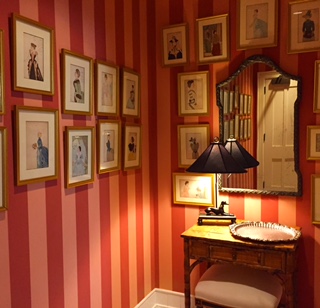
The seemingly cluttered and uneven photo alignment is 
made possible due the well balanced and centered table
& mirror. 
The length and height of stair risers. All of which are meticulous averages, which years of usage in the world have managed to come by. These "lowly" mediums are the anchors of our day to day life, the blocks from which we are allowed to soar to different places. In my view "Average" should be proclaimed as a new goal, a place we all should aspire to reach, a balance that redefines our center lines, and alignments. A Happy Medium. 


Monday, November 9, 2015

Design on the Run

The other night as I meticulously laid out my pre-race paraphernalia on the dinning room table, a familiar sensation hit me. It felt like the night before a final review or a big client presentation. 

A festive almost religious like rhythm and movement comes to mind. Picking out the right running clothes, the socks, the race number, the power gels, the good luck charms, uploading the right playlist. 
Until running my fourth big run, I never realized how much the design process and long distance running have in common. 


Pre-race layout
I always worked while listening to music, a beat to which I would carefully glue the model pieces in their right place, or hand draw the envisioned elevations. When I look at past work, I will always know which tune I was listening to at that time. Every race I go to I have a playlist ready for the rhythm needed for that part of the run, the warm up music will be different than the one for running up that very long hill. Design projects will have the same process of warming up (brainstorming, sketching, etc.), the long and tedious main course of the run (building, permits, fixing mistakes), and finally the dash to the finish line. 

Long distance running requires training and careful planning. Good design does too. I miss having that process followed to a T. The haphazard approach people have to the design process creates for a lot of contention and costly mistakes. It's almost akin to a 5K runner suddenly asked to run the Boston Marathon over night. The damage that can happen to the runner is clear. The same is true for the design process, there is a careful methodology to it, and when short cuts are made in that process, spaces seem incomplete or just don't look or feel right. 

The most successful, and rewarding projects I have been a part of, are the ones when I'm allowed in on the 'warm up' phase. From the point of helping decide which space will work better for a new office, and its growing team; to running up the hills of painful budget decision making, and exciting new spatial moments, which in my heart I know will make for the best working environment for that team. 

Office kitchen lounge in the making 
And like with running, going all the way up to the finish line, when every fiber of my being is dead-on focused on getting it done right and on time, (the counter top edges should be mitered, the layout of the flooring, and the thermostat should not be in the middle of the feature wall...) one foot after the other. 

Tuesday, October 20, 2015

No Name *

Branding // 
(as noun branding) The promotion of a particular product or company by means of advertising and distinctive design
Seems like everywhere you turn around these days one is expected to brand themselves, their work place, their product, you name it. That elusive quality that will distinguish them ahead of the pack, any pack. Starts from your web site landing page, Facebook page, twitter account, tumbler feed - you name it, you'll need to brand it. Better yet tie it all into THE brand. 

But you see good branding is hard to achieve these days, it requires something most of us don't possess - patience. In this fast track world of FB, snap-chat, insta tumbling sound bites it seems that no one is free from creating their own brand. A "brand" represents quality, identity, a vision of sorts if you will. Maintaining ones brand has become such an important asset, because we live in such a fast paced #imoutofthegame world. This branding process so precisely captured in Ecclesiastes (7:1)  'A good name is better than precious ointment' . 


A good brand will be created over time. This is where it gets tricky, especially, in the world of start-up companies who are by definition are required to move in an almost counterintuitive way of branding - most are required to break/invent a mold while maintaining a facade of 'respectability' as they are accounted for the funding they have recently secured.
Now imagine what it is to design these spaces? Where the unknown needs to be translated into literally brick and mortar. Where there is no clear brand or identity, yet the one thing that is expected, aside from keeping it all within a tight budget, is creating a space that will represent the company and the brand it hopes to stand for. It's a huge privilege and responsibility to be part of that process.


Tuesday, July 28, 2015

Blank Space

This weekend I was at a Taylor Swift concert in a massive football stadium. And at the risk pitting the world of 'Swifters' against me, I'm going to be forward and say it was just OK, if not border line boring and uninspiring. So much so that even my 9y, who has waited since February (her birthday gift), asked to leave the place about an 45min after Ms. Swift made her way on stage.

That to me was very telling and made me think why was it just an OK concert. Why wasn't I moved by this talented, and in my view, extremely intelligent woman. Everything was OK the lighting, the weather, the audience... Everything was pleasant and comfortable so numbingly comfortable. It was right out plain and boring like a slice of white bread. And that worries me, the kind of worry I lose sleep over.

Years ago I worked at a lighting design firm in Tel-Aviv. It was an extremely unique opportunity to hone and deepen my design skills. I worked with many light fixture manufacturers from around the world. On very rare occasions I would specify American fixtures, it had nothing to do with voltage differences, it had to do with the fixtures themselves. They were OK, they were functional, and of high quality, but they were not interesting, they did not move me emotionally or tell a story through their design. Like Taylor Swift, they too were making me feel numb.


This is why I worry, I worry because people like TS have a huge impact (Swift vs. Apple corporation, anyone?), the trickle down effect of her incredible abilities were reduced so much in the concert I attended, it felt I went to see a totally different singer than I expected. But TS's concert to me is only one symptom of how our culture is been driven into this Hunger Games numbing spiral of sorts. From quick fix reality TV shows, easy on the eye FB profile photos, to very pleasant concerts, who leave no actual mark inside our souls.

And it's an issue, because the great cultural legacy we will leave behind, might turn out to be very
dull and uninspiring. Which in turn will make our society very beige and lackluster.

For the sake of my 9y and her two other siblings I want to deepen the cultural legacy, so that their wings can spread wider. I want them to learn how to push the envelope, set out from the comfort of the box and get a little uncomfortable, so they too will better understand how to create, how to solve problems on their own not according to templet, so they won't grow to be culturally and emotionally numb. So they won't end up in a blank space. 

Monday, June 22, 2015

All Work and lots of Play

During my graduation ceremony way back then, our class speaker, diligently taped crayons to the bottom of each and every seat, it was an apt reminder from where we all started.
Designers like to play, our whole world resembles a blown up pre-school classroom. We experiment with color, light, shapes, texture, but unlike the carefree kids with fingernails clogged by green play-dough, proof of concept lies on our shoulders.

Play, the new hot word in the design world, is a very intricate tool. As boundaries of work-home environments are blurred and redrawn, the in-between becomes a vital regulator that assists in balancing the two. We all know, and research shows that people who have a more balanced work-life world are usually more productive at their jobs. I've been around the high-tech start-up community long enough to know that research is nice, but not always easy to attain. Some like the big high-tech companies in California, will even go as far as adding a huge slide to connect between two levels (though I've heard the noise made them close it off). In areas where the weather is consistently good there will be a hiking trail near by, in the north-east this option is good for maybe 2-4 months out of the year. The challenge is always to create a "play" zone without it being disruptive, too juvenile, and consistent. Because structured play is extremely important for creative processes, and office culture.

Along the years I've learned that most places I think of as the "right" off site, breakout zones in the office program, usually become last on the priority list of company leaders. This is usually due to budget and space constraints, and/or lack of will to create these seemingly money and time wasting spaces. I used to worry a lot about these spaces, I mean after all I'm a professional player (ahem..designer). I'd cry over the lost lime colored bean bags, that will never make it to the right spot. But then something interesting happened, some spots got filled with junk - yes. But others got organically filled by the people who work there. Old school video games popped up, an old sofa picked up from a curb made it in instead of the lime green bean bags. Some even took away the custom made tables from the kitchen to create a totally new off site area in the middle of the open space. A natural playground was born, a new and unique office culture has been cultivated through the lack of over designing "play". I guess designers are not the only ones who like to play with space, allowing other people to join in the fun of experimenting with space is a powerful tool, kind of like rediscovering how to use crayons again.  


Monday, May 18, 2015

The Sound of Silence


The basic need of quite in one's life can't be underrated. Research shows that being around noise pollution sources can cause serious health issues. That is why cities have guidelines pertaining specifically to the issue of noise.

What is interesting to me as a designer is creating quite zones, and moments with-in a space. Best example I had encountered of coming in and out of silence is in a swimming meet. I often ask my daughter, do you hear us cheer? With a big smile over her face she says, "no it is so quite in the water it's the best thing". The silence of the water keeps her safe from the competition's stress.

Many commercial places make the mistake of cranking up the volume, to a point of complete disorientation, it seems these are the places, that are starting to see cuts in revenues. Noisy restaurants may seem appealing when you walk in, but the charm of the loud music or boomy chatter wares you down, and asking for the check seems like the right exit move. Even hectic cities take a toll on people. I know that I love to visit New-York city, but I've learned I also like to say goodbye.

The basic way sound works is by traveling through some sort of medium like solid, liquid or gas, by vibrating the molecules. The density of the medium (spacing of the molecules), will determine how fast the sound will travel through it. The denser the medium, the faster sound will travel through it. So hard table tops, combined with hard flooring surfaces and bare walls - make for a very boomy and loud environment.

There are ways to mitigate some of the noise disruptions. I've seen people wear noise reduction headphones on airplanes, and open office spaces. There are special rooms where one can leave the open space to take on a phone call in a more private setting. Carpets and their padding also help. Architecturally walls can be built with more sound proofing - mainly by adding air of sorts. Anything that will help keep the house warm or cold, will also help with sound proofing i.e. foam insulation, double paned windows. In some restaurants I have seen foam padding under the table and seats (not a pretty sight). Some public places even go to the extreme and use a 'high-pitch' device to keep younger people from loitering and making noise around the area.

But I have to admit these solutions are usually not visually pleasing. Yes we can put more and more rugs or carpets, but what if there are allergies, or we just like the look of hardwood floors? Just googling the words 'sound proofing' brings up pretty basic solutions, some are more pleasing to the eye, some less. I have even once found there is a whole world of sound proofing art work (basically felt cut into landscapes).

Any of these things can help, but I also think that as our living areas get more condense, there should be a behavioral change in our environments. I don't need to walk into a store where the music is cranked up, or a bar where the hockey game is put on so loud I can no longer sit in there. I want to enjoy looking a things in a store without having the urge to bolt, I want to enjoy my dinner with a side of the hockey game not IT being the event. I really want as Simon and Garfunkel so aptly sing is to enjoy The Sound of Silence.


Monday, May 4, 2015

The First Impression is the Deepest

First impressions are lasting impressions, this usually is said, in reference to meeting new people. The same holds true to spaces people walk into. The psychology and research behind this tenth of a second moment are extensive and interesting to read about. Our conceptions (misconceptions), primal thoughts, fears, judgment are all in hyper-mode when we first encounter a person or space.

When I first walk to meet a client, usually at their home or office, I pause just a few seconds before I enter. And after adjusting the sunglasses over my head, I'll take a deep breath and walk into the space - trying to make the most of the that tiny instinctual first impression moment. That moment to me packs a powerful tool I draw upon time and time again throughout the whole design process. It's an authentic rare and fragile moment, and trying to re-create or change that moment, especially for small businesses, is a challenging process. That first impression usually sets the expectation and mode of the encounter. Same as people put effort into the suit they will be wearing the morning of a job interview, that same care and effort should be taken into creating that fist impression moment of entry to a space. But most of us neglect that unique and one of a kind transitional entry space (be honest now - how does your home or office entryway look like?). It's usually  last on my client's list to invest in, especially at an age where having a reception area is becoming more more obsolete. Herein there lies the biggest mistake I feel many do.

Stop for a moment and think about any event you walk into. Break it down to every millisecond you were there - were you hot or cold, did anyone greet you, how did the space smell, was the light bright or dim, were you able to orient yourself easily, was the ceiling high or low, was there anything that caught your eye, how was the sound around you, was it crowded, were you able to find a place you'd feel comfortable standing in. The reason I ask you to break down that first impression feeling at an event, is because when entering one, we come geared up to absorb these details. Now ask these questions about how you feel when you first walk into a job interview at your future company. Try and notice what are the first things you see/feel/smell/touch. I urge many clients to put some effort into that space (a good example of grand scale entry spaces are hotel lobbies).

The best first impression masters I can think of is actually the Catholic church. Any big cathedral will have the same sort of look and feel to it (brand and corporate identity reenforced by design); A grand entryway, then as you walk through the door the ceiling above you is lowered to create intimacy or make you feel small and meek as your eyes are automatically drawn ahead of you, where the ceiling is an unimaginable hight, and a clear line of vision is set to the one of the most recognizable icons in the world. A perfectly orchestrated  first impression delivery. 

Think about your brand-identity, or as it's now being called, company culture, not only in terms of web presence, letter heads, cool lounge areas, and logos. Think about the message you'd like to convey in that fleeting precious first impression moment.