Monday, September 26, 2016

Losing Touch

Making coffee to a group of designers/architects always proved to be challenging. Never mind the personal taste they each had of how to drink their coffee, but you couldn't even pour it into the mugs lined up, everyone switched them up. 
It was almost ritual like -- one would come to the mugs lined up on the countertop, pick the mug up turn it 15 degrees left, then right, then look at the bottom of the mug, only then would one hold it with both hands, and if it felt like the right fit for that day -- you were able to pour the coffee into the mug. I can not make this stuff up. 

In the last few years more and more tactile biofeedback giving elements of our lives are disappearing. From the click-click-click of the typing machine to a touch screen, from turning a key to operate a car to pushing a button. It's almost like we are losing the ability to feel what we are supposed to do, that we are unlearning our brain to be able to decipher nuance of touch, a very primal part of our being. Some will claim this is part of evolution that it's not as bad as I think it is. But to me any ability we use to read our environment that is lost, is a shame. Any person who suffers from arthritis will attest that loss of sensation is almost like a phantom pain. 

Our society is suffering from this ability to feel contact. Though there are many trends of ergonomic seating, stand up desks, and special handles, they are already being built with the mindset of losing touch, not retaining it. 
In her book Sensation - the new science of physical intelligence, author Thelma Lobel describes how these moments of physical contact with everyday things, like drinking warm coffee before entering an important job interview, or switching on a light switch can trigger different sensations and spark new ideas and feelings. 

I'm not against moving forward while we make easy tabs available for toy manufacturers, but just being mindful that we also need to be conscious of the "touch free" environments we sometimes crave and create and what it must be doing to our soul. 

Monday, September 19, 2016

Time for Some Retail Therapy


"If you could be any store in the world, what store would you be?"

It's the first questions I ask first time clients when I meet them. Sounds like a silly almost juvenile type of question, right? But the response to this question loads me with so much information about a person's personal design sensibilities. Just the word IKEA evokes immediate visual and sensory reaction from any person -- the light birch color, clean lines, smell of cinnamon baked goods, bright light. 

But in the past few years or so things have shifted, it takes a person longer to respond to that question without being cynical and saying "Amazon". But that too is very telling. Our time has become a valuable commodity and between the hussle of very full and active family lives, and increasingly harder to balance work schedule -- going out shopping is not much fun anymore, where is in the past it was considered therapy. To me it feels like going into a teenagers room wanting to pick up after them.

Yes the economy was hit hard and we are in the odd in-between years of trying to marry good UX online with somewhat of a decent similar experience in brick and mortar storefronts - hey even Amazon is opening one! There is value for people to go out and shop, bump into friends, walk around and engage in different environments, while they consume more useless products. We humans need to have a purpose and meaning even if it's a simple one of getting a bar of soap. Most of us don't have a nice park or open space around us, the streets and shopping plazas become these communal arenas. 

Yet we are greeted with visual cacophony, most of it following "design rules" that pre-date the immediate click-of-the-button-swipe-of the-fingerprint era -- Loud music, harsh smells, disorienting product placements, bright lights, low or no-inventory that can easily be found online, a tired salesperson, long lines to pay or return items. Most of these stores are run down, people who work there are annoyed and tired because of entitled "let's just scan this items" consumers. The whole shopping experience has been reduced to that moment of email confirmation of "your item is on it's way". 

It's no secret these retailers are struggling, closing down stores leaving gaping holes in shopping malls, street plazas, and city centers. Which in turn leave us with almost ghost like places. Retailers have yet to make the adjustment to this new world of shopping experience, it's almost like they are at a loss and have given up completely. Like all of us in these odd and fickle economic times they too need to rethink cost-per-sqft or ROI -- yet we humans are not only the sum of that. And our reaction to the lack of seeing us as human in need of contact, efficient, pleasant places to be and interact in is that of that going online. 

Smaller more humanly accessible stores, where one can see the end of it, where there is some inkling experience that makes us pause, smile and give us a meaningful break in our day will go a long way in improving retailer's bottom line and user experience. I want to go back in time to the feeling of excitement I had at the end of the 90's start of 2000's when I pounded the streets of downtown trying to find the next big WOW moment that was supplied by exciting store designs that even the biggest names in architecture at the time were not ashamed to be part of. 
We all lose when a layer of our needs is taken away, and another human factor is lost into the efficient sterile cyber zone. 

Monday, September 12, 2016

Something in the Way

Life gets in the way. It does. So many times I wish for a bubble to be able to think, or at least manage to put 2 and 2 together, without it becoming 5. 

But then again this bubble utopia I wish and long for does not truly exist, even if it did -- would it make it easier to work in this uninterrupted world? I find that in most cases though, as a tell my active 7y, silence is golden, it's sometimes (ok most times) paralyzing. That the "noise" generated by the things around me, hold in them the true grain of creativity. When I'm presented with a "blank" canvas space, where there is nothing to bounces off thoughts from, is when it really gets tricky. 

The challenge is, most commerical spaces are like that, blank, nothing bouncing off right at me. Which is hard, very hard to come up with a narrative or meaning, if you will, for these spaces. So how does one marry love, passion, and creativity into spaces that obviously need the most attention? It becomes a journey of looking into how to amplify some of the hidden "noises", create meaning.

The average American office interior spaces and their design are almost always neglected, and over the years they have been left at the hands of cost per SQFT demands, business cooperations, market trends, real estate forces, furniture manufacturers, and various management theories - but almost never at the hands of the end user - the "average" office worker.
In his book “The European office” Juriaan van Meel proclaims “Office buildings (...) are perhaps the most important building types of the 20th century… They dominate the contemporary city and accommodate more than half the working population in the Western world”.
That to me is mind blowing information - more than half of the working population in the Western world!!! Which on average spend 47 hours a week in these buildings, which is more hours spent sleeping a week, or almost three times more hours spent with immediate family. 

So whenever I walk into a blank space, I keep that piece of information in the back of my mind, because so much time spent in such neglected spaces affect not only the person using them, but society as a whole, it should get in the way, because life gets in the way. 

Wednesday, January 6, 2016

"Calling Elvis, is anybody home?"*


When was the last time you actually had a conversation with someone? Face to face, or on the phone? I don't seem to remember when this has happened to me last, but it seems that in the rush of life, we've stopped talking, and started communicating through text messaging of any kind, emoticons, and links to the latest TED Talk, but I miss listening to peoples voices. The warmth of the tone of voice is lost, which we try to make up for using silly emojis. 

Some may argue that with these communications tools the revival of the lost art of writing has come back, but has it? A few months ago I had the pleasure of listening to Israeli typographer Oded Ezer, at MassArt, in Boston. Ezer had provocatively stated that text is dead, and we are headed to a place where people will end up communicating with images, photos, and videos. I have to admit this kind of freaks me out. I love text, I use it to help me think, I use it in my design work. Text, is a powerful tool of communication, but so is the lost art of talking to each other, interrupting each other, yelling, and whispering a lovely good night. We lose the ability to be compassionate when we don't hear the tone of voice. 

In the past I have wrote about how the challenges of an open space concept in an office environment created this muted existence within the space. But the actual silence is misleading as there is a lot of online and virtual chatter. I'm not against online or virtual communication, I like using social media, and acknowledge its value (as I tell my 6 year old son, not everything needs to be said out loud). I just wonder what this does to the culture of a company, the casual "water cooler" conversation where people would physically move from their desks, and seek out other people to exchange some ideas, have real eye contact, measure and learn peoples expressions, and interact with the whole complex package of what we call human beings. Office spaces are losing these interaction spaces not only because of the price per SQFT, but also because they are not used as much. We need these interaction spaces, people forget to look up from the screen and just say hello.  

What does it do to our society as a whole, how much disconnect is created through these seemingly amazing tools of communications, how have we become these machine like responders to beeps and vibrations?
How our articulate kids are losing the ability to carry a non scripted conversation. 
I think we need to call Elvis... 

*Lyrics by Dire Straits


Monday, November 30, 2015

FFF

FFF. Form Follows Function. Every contemporary designer aspires to reach THAT moment of the (in)famous concept of clarity in design. The term is a simple way to describe a level of purity in design. A moment where all the ornaments are pealed back, and you are left with the bear minimum needed to sustain the function of the chair/building/kitchen. 

Alexa's beaming 'circle of death'
This weekend as we were putting our christmas tree up, we were joined by a new member to our technical family - Alexa; a wireless voice activated speaker. The joy in our household quickly fizzled as it was clear Alexa was all Function and no Fun, the ultimate electronic FFF. Unlike Apple's Siri, Alexa would not respond to silly questions my 6y boy had come up with, leaving him hanging with her blue round 'circle of death' (as my 10y calls it) beaming in front of his eyes. I'm no Siri fan, to be honest all these voice activated devices make me feel uneasy, but at lease she has some artificial intelligence sense of humor built into her. 

Looking deeper into pure functional form of things is a true design exercise. I'll be the first to admit that I too, am a purist, coffee will be coffee no hazelnut-vanilla flavor for me, and I admire clean modern lines in clothing, furniture, light fixtures, and spaces. Usually things that are made to function well, will be less wasteful and harmful to our environment. BUT then I find something is lacking. A human touch, a smile, a sprinkle of sparkle. 

As we brought in our christmas tree, our usually clean lined home, suddenly became friendlier. It smelt like pine, and by the time we were done decorating our spirits were happy and joyful. If ever there was an antithesis to FFF - it's christmas. It's not sustainable, no clean lines, no function what so ever, and full of ornaments. What a christmas tree lacks in function it makes up for in full blown spirit, a magical feeling that we can put last year and it's troubles to bed, that rejuvenation is on its way. Not functional, yet truly valuable for us as humans to feel. 

We should not want to live an a highly functional society that in many ways acts like Alexa. Just looking into the personalities that have brought the likes of Siri and Alexa to the world will allow us a window into the algorithms that rule our day to day searches, and more important - finds. They narrow our peripheral view of things in life, they eliminate exploring further in new ways. This is alarming because as much as I like clean lines, and functional spaces, I love having happy sloppy and messy mistakes that allow me to pause and smile, remind me that after all I am human that not only Functions but also Feels. 

Monday, November 23, 2015

Happy Medium

There is no bigger evil in the world of the over achieving, insta-go-getting, facebook high rollers, than the word m-e-d-i-u-m. It's this stuck in the middle, static, neither here nor there option in life. It's not the cream of the crop, or the lowest of the low. A mentality of 'I'd rather miserably fail than be defined as mediocre'. No wonder there is the known phenomena of the "mid-life crisis". There is no sex appeal in middle. 


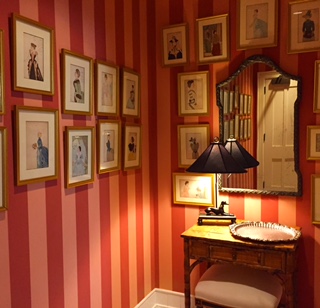
The pink logo creates a surprise in a 
well balanced space 
Or is there? 

It seems that humans have developed this odd, almost counter intuitive knack, to push boundaries, which is completely against any natural instinct. Nature always wishes to balance, to reach equilibrium. We as humans want for some unknown reason to defy that force of nature. We sleep less than we need to, we eat more than we should, we work longer hours, and in general don't really take very good care of ourselves and our environments. 

As a designer I like to keep things off balance, surprise the user of the space. I'll use bold colors where you won't necessary expect them. I'll align certain things that will keep you on your toes. But it's a delicate process that can't be done on a whim. These mis-alignments can only be done right when you have a balanced and clear idea, and when there is a solid anchor you can play off of. Otherwise it creates clutter, uneasiness and in general a feeling things were not thought out properly. So there is, you see, a certain method to the design madness. 

That is why a Happy Medium is one of the most critical things in our daily lives, and is one
of the hardest things to come by. (Ask any GC trying to level floors inside old homes). We need the temperature of the HVAC to be almost exactly the same in our work environments. Lighting and its brightness need to be precise. The height of our kitchen countertops is meticulously measured. 
The seemingly cluttered and uneven photo alignment is 
made possible due the well balanced and centered table
& mirror. 
The length and height of stair risers. All of which are meticulous averages, which years of usage in the world have managed to come by. These "lowly" mediums are the anchors of our day to day life, the blocks from which we are allowed to soar to different places. In my view "Average" should be proclaimed as a new goal, a place we all should aspire to reach, a balance that redefines our center lines, and alignments. A Happy Medium. 


Monday, November 16, 2015

Mindful Act of Kindness

When my soon to be 10 year old girl was about 4, she was brushing her long golden hair. She looked up at me and asked 'why do I need to brush my hair each and every morning?' My response was 'because by doing so you respect yourself, and respect your friends and teachers'. 

I was never a fan of Feng Shui, or to be precise, its watered down western interpretation of it; Closing the toilet seat to prevent your money escaping your wallet, never have a staircase facing the front door, never put a chair with its back to the door - are some of the highlights I can off handedly suggest. 

But a few years ago I had this small epiphany of why it mattered in our world. Why habits like making sure you don't squeeze the toothpaste in the middle mattered, why making your bed every morning matters, why putting a fork and knife in the right order matters -why these seemingly mundane tedious, and routine things matter. They create order, they create balance, and for control freak megalomanic designers (hey we are paid to build 'worlds') are a code and key to understanding human interaction and behavior within different environments and spaces. 

These random daily routine acts are mindfully observed and broken down frame by frame to create a narrative for a space. These 'mindless' acts being thought of mindfully are the difference between getting furniture straight out of catalog, only to discover these don't make your house feel like a home. 

It's attention to details in ways that are not obvious to the user of the space, but they make the user feel good happy and safe. They make people feel like they are cared for, and not taken for granted, that even though you can't exactly pinpoint what it is that makes you feel connected, you know you are. That yes, even brushing your hair in the morning, matters. It's a small act of kindness to yourself signaling that you will also make sure to be kind to others.